The Evolution of Cinema Sound
Dolby CP50
When better sound became practical enough to change the theater experience.
Today, moviegoers expect sound to surround them. That experience did not arrive all at once. Introduced in 1976, the Dolby CP50 Cinema Processor became part of an important transition: making multichannel optical sound practical for many more movie theaters.
Listen to the Story
When Better Sound Became Expected
Hear the story of how improved cinema sound moved from technological possibility to something theaters increasingly needed in order to meet changing audience expectations.
Before the CP50
Stereo Cinema Already Existed
The important question was not whether multichannel sound was possible. It was whether theaters could use it practically, reliably, and affordably.
Stereo sound in movie theaters did not begin with the Dolby CP50. Earlier magnetic soundtrack systems had already demonstrated that films could use multiple channels of sound to create a much wider and more immersive experience.
The problem was that being technically possible did not automatically make a technology practical for everyday theatrical exhibition.
Magnetic sound systems could offer impressive performance, but they also added cost and complexity. Theaters needed compatible playback equipment, while distributors had to produce and supply appropriate prints.
Dolby Stereo optical sound offered a different path. By carrying stereo information on the film’s optical soundtrack, it helped reduce some of the barriers that had limited wider multichannel adoption.
That is where the CP50 becomes historically important. It did not invent stereo cinema. It helped make a better cinema-sound experience practical for many more theaters.
It Has to Work
Engineers first have to prove that a new format can genuinely improve the theatrical experience.
It Has to Be Practical
Theaters must be able to afford the equipment, install it, maintain it, and obtain films that can actually use it.
Audiences Begin to Expect It
Once enough theaters adopt the improvement, what was once a premium feature can gradually become part of the expected moviegoing experience.
The CP50 belongs to the moment when the question was shifting from “Can cinema sound do this?” to “Can more theaters realistically offer it?”
The Audience Experience
What Changed When Sound Became Directional?
The shift to stereo was not simply about adding more speakers. It changed the relationship between the picture on the screen and the sound heard throughout the auditorium.
The Earlier Experience
Sound From the Screen
With conventional mono reproduction, the soundtrack was essentially presented as a single channel. Dialogue, music, and effects were largely associated with the screen directly in front of the audience.
The Expanding Soundstage
Sound Across — and Around — the Room
Multichannel stereo allowed sound to be distributed across the front of the theater, while surround speakers could carry selected effects beyond the screen and into the auditorium.
Connected to the Picture
Voices and other important sounds could remain closely tied to the action happening on the screen rather than feeling detached from the image.
A Wider Soundstage
Music could spread across the front of the auditorium, creating a broader and more enveloping presentation than a single-channel system could provide.
Beyond the Screen
Surround effects could extend into the room around the audience, allowing the auditorium itself to become part of the cinematic experience.
Stereo was not simply a technical improvement. It gave filmmakers another way to shape where the audience looked, what they noticed, and how deeply they felt connected to the world on the screen.
Inside the Sound Chain
How the CP50 Fit Into the Theater
The CP50 was not the speaker system and it was not the soundtrack itself. It sat in the middle of the process, turning information carried on the film into signals the theater’s sound system could reproduce.
A Simplified Cinema Sound Path
The Processor in the Middle
A film’s optical soundtrack first had to be read by the projector’s sound system. That signal was then sent to the cinema processor.
The CP50 processed and decoded that signal, preparing the soundtrack for reproduction through the theater’s audio system.
In a Dolby Stereo presentation, information carried on the film could ultimately be reproduced through the theater’s left, center, right, and surround channels.
The CP50 therefore acted as a kind of control center between the soundtrack on the film and the equipment that actually produced sound in the auditorium.
Read the Soundtrack
The projector’s sound reader converted the optical information printed on the film into an electrical audio signal.
Process the Signal
The CP50 handled the soundtrack according to the selected format and prepared the appropriate channels for playback.
Fill the Auditorium
Amplifiers and loudspeakers reproduced those channels, transforming the processed signal into the sound heard throughout the theater.
Projection Booth Controls
Reading the Front Panel
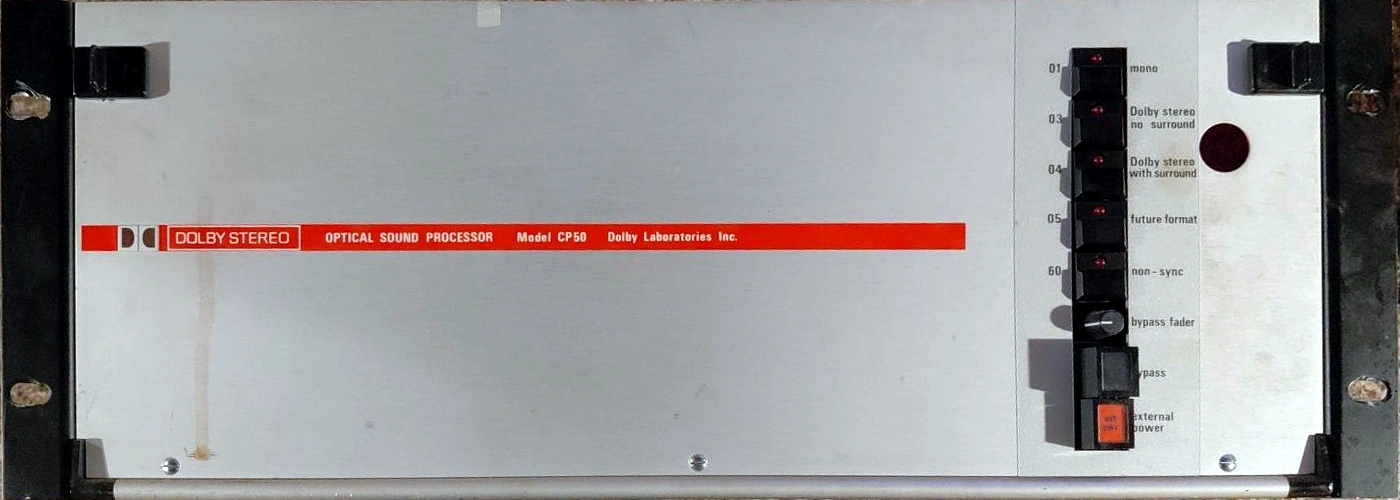
The controls on the CP50 reveal something important: different films and different situations required the theater’s sound system to operate in different ways.
Mono
Used for conventional single-channel optical sound. The soundtrack was reproduced as a mono presentation rather than decoded for stereo and surround playback.
Dolby Stereo — No Surround
Allowed stereo playback across the screen channels while leaving the auditorium surround channel out of the presentation.
Dolby Stereo — With Surround
Used the multichannel Dolby Stereo presentation with the theater’s surround speakers included, allowing selected sound to extend beyond the screen and into the auditorium.
Future Format
The front panel also provided a position for a future format, reflecting the expectation that cinema sound technology would continue to evolve after the processor was installed.
Non-Sync
Used for audio that was not synchronized to the projected film, such as music played before the feature, during an intermission, or at other times when the projector soundtrack was not the source.
Bypass
Provided a fallback operating mode so that sound could remain available if normal processing could not be used. In a theater, keeping the show running could be just as important as achieving perfect reproduction.
Look Inside
A Machine Designed to Be Serviced
With the cover removed, the CP50 reveals a design philosophy that mattered greatly in professional cinema: important parts of the processor could be serviced, replaced, and improved without replacing the entire machine.
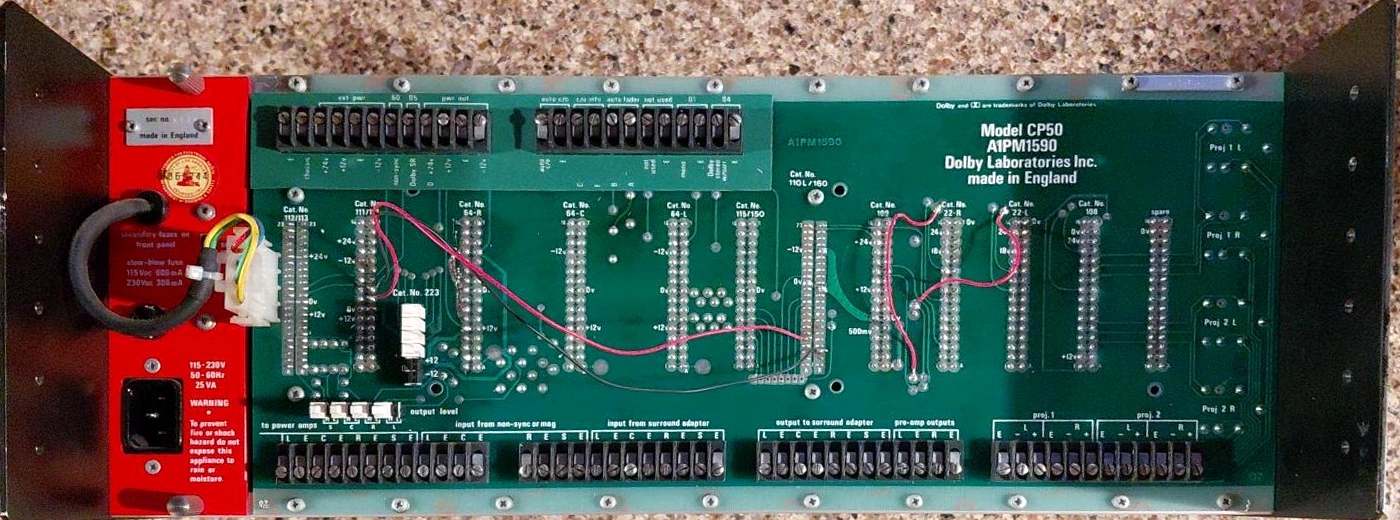
What Does “Cat. No.” Mean?
Specialized Circuit Modules
Across the CP50 mainboard are positions labeled with Dolby Cat. No. identifiers. These catalogue numbers identified specific circuit modules used within the cinema processor.
Different modules performed different jobs within the sound system. Depending on the configuration and later upgrades, those functions could include areas such as signal processing, decoding, equalization, noise reduction, or other parts of the playback chain.
Instead of building every function permanently into one large circuit assembly, Dolby could use removable modules designed for particular tasks.
Replace the Failed Part
A technician could diagnose a problem and, where appropriate, service or replace an individual module rather than discard the entire cinema processor.
Improve the Existing System
As Dolby refined parts of its cinema technology, newer versions of some circuit modules could improve the performance of processors already installed in theaters.
Protect the Investment
Professional theater equipment represented a substantial investment. A serviceable modular design could help keep that equipment useful as long as practical.
Technology and the Theater Business
The Cost of Keeping Up
Better sound did not begin and end with the cinema processor. As soundtrack technology improved, the rest of the theater often had to improve with it.
One New Format Could Affect an Entire Auditorium
New cinema sound formats could place greater demands on far more than the processor in the projection booth.
Greater dynamic range could require more capable amplifiers and loudspeakers. Improved surround reproduction could require additional speakers, better placement, and careful equalization. Deeper bass could require dedicated subwoofers and additional amplification.
Even quieter passages created challenges. To reproduce them properly, a theater also had to control background noise, vibration, sound leakage, and other distractions in the auditorium.
A major technology upgrade could therefore become a system-wide investment, rather than the purchase of a single new piece of equipment.
Amplifiers
Soundtracks with greater dynamic range could require more amplifier power and additional headroom to reproduce peaks without distortion.
Loudspeakers
Screen and surround speakers had to handle the required frequency range, output level, and coverage throughout the auditorium.
Subwoofers
Newer formats could demand deeper and more powerful bass, requiring dedicated low-frequency speakers and amplifiers.
Surround Systems
Surround sound worked best when enough speakers were properly positioned to create even coverage without making the nearest individual speaker obvious to the listener.
Equalization & Testing
A quality sound system had to be measured and adjusted for the characteristics of the auditorium rather than simply installed and switched on.
Acoustics & Noise Control
Background noise, reverberation, sound isolation, and even auditorium construction could affect whether the audience actually heard the benefits of the new technology.
The Upgrade Chain
A new format could create a chain reaction.
For theater operators, technological progress has always raised
two difficult questions:
Can we afford to upgrade?
And eventually…
Can we afford not to?
The Other Side of Progress
When Upgrading Stops Making Sense
Professional equipment can often be repaired and improved long after it is first installed. But eventually, technological progress reaches a point where replacing the old system becomes more practical than continuing to modify it.
Install the Technology
A theater invests in equipment that meets the formats, expectations, and operating needs of its time.
Repair and Improve It
Components can be serviced or replaced, and newer modules may extend the useful life or improve the performance of the original system.
Replace the System
At some point, the cost and complexity of adapting older equipment can exceed the practical value of keeping it.
The CP50 Was Able to Evolve — Up to a Point
The CP50’s modular construction allowed parts of the processor to be serviced and, in some cases, replaced with improved versions as cinema sound technology developed.
Dolby’s later technical guidance discussed updated circuit modules with improvements in areas such as optical preamplifier performance, matrix decoding, dynamic range, and noise.
That meant an older processor could sometimes continue to benefit from newer technology without forcing the theater to replace the entire unit.
But modularity could only take the CP50 so far.
Keep Upgrading the Old Processor
Modify the existing equipment, install additional or updated components, invest technician time, and continue adapting a system originally designed for an earlier generation of cinema sound.
Move to a Newer Processor
Invest in equipment designed around the newer generation of soundtrack technology rather than spending a comparable amount trying to extend the older platform.
The Continuing Technology Cycle
The question facing a theater eventually changes from “Can we keep this equipment working?” to “Is keeping it working still the best investment?”
When Audiences Began to Notice
The Star Wars Moment
New technology often needs the right movie to show audiences why it matters. For Dolby Stereo, 1977 became an important turning point.
Dolby introduced the CP50 as a more economical cinema processor for 35 mm Dolby Stereo optical releases.
Then Came 1977
In May 1977, Star Wars opened in 46 U.S. theaters equipped for Dolby Stereo.
Later that year, Close Encounters of the Third Kind provided another major showcase for the format.
Dolby’s own historical chronology credits films such as these with sharply increasing public awareness of Dolby Stereo and encouraging additional theater installations.
The significance was not simply that better sound technology existed. Large audiences were now hearing what it could do.
Technology Without Awareness
A format can exist without most moviegoers knowing or caring what equipment is reproducing the soundtrack.
A Film Makes the Difference Obvious
A major release can give audiences a memorable demonstration of what a new presentation technology adds to the experience.
Expectations Begin to Move
Once audiences encounter a better presentation, theaters have another reason to consider whether their existing systems can continue to compete.
The CP50 arrived at a moment when Dolby Stereo was moving from an emerging cinema technology toward something increasingly visible — and increasingly expected — in the moviegoing experience.
The Continuing Evolution of Cinema Sound
From Surround to Immersive Sound
The CP50 belongs to an earlier generation of cinema technology, but the larger idea behind it continues today: sound does not have to remain confined to the screen.
Mono
The soundtrack was essentially reproduced as a single channel associated with the screen.
Stereo & Surround
Sound could spread across the front of the auditorium while selected effects extended into the room around the audience.
Immersive Sound
Newer systems can give filmmakers far more precise control over where sounds appear and how they move through the listening space.
The Auditorium Became Part of the Soundtrack
One of the important changes represented by systems such as Dolby Stereo was the idea that cinema sound could extend beyond a single point behind the screen.
The front soundstage became wider, and surround channels allowed certain effects to reach into the auditorium.
Later generations of cinema sound continued developing that idea. Digital systems could provide additional discrete channels, greater dynamic range, wider frequency response, and more sophisticated surround reproduction.
Modern immersive systems take the concept further still, giving sound designers much greater freedom to place and move sounds throughout the theater.
Widen the Screen Sound
Stereo made it easier for sound to correspond with action occurring across the width of the picture.
Reach Into the Auditorium
Surround channels allowed selected sounds to extend behind and around the audience rather than remain entirely at the front of the room.
Shape a Three-Dimensional Space
Modern immersive systems can provide far greater control over the apparent location and movement of sound within the theater.
The equipment has changed dramatically. The goal has remained remarkably consistent: make the audience feel less like they are watching a movie from the outside — and more like they are inside its world.
Looking Back
Why This Object Matters
The CP50 is more than a surviving piece of audio equipment. It helps explain how technology actually changes the moviegoing experience — and why that change rarely happens all at once.
More Than a Sound Processor
The CP50 represents the moment when better cinema sound became practical enough to spread much more widely.
Stereo cinema already existed. Engineers had already shown that movies could sound richer, wider, and more immersive. The challenge was turning that possibility into something ordinary theaters could realistically install and use.
The CP50 became part of that transition. It helped theaters reproduce Dolby Stereo optical sound at a time when multichannel presentation was moving toward wider adoption.
And once audiences experienced better sound, expectations began to change.
A Pattern Repeated Throughout Cinema History
Collection Reference
Artifact Details
- Object
- Dolby CP50 Cinema Processor
- Manufacturer
- Dolby Laboratories
- Introduced
- October 1976
- Made In
- England
- Primary Use
- Theatrical soundtrack processing
- Associated Format
- 35 mm Dolby Stereo optical sound
- Design
- Rack-mounted modular cinema processor
- Internal Architecture
- Removable Dolby Cat. No. circuit modules
- Collection
- Tahqua Land Theatre
- Historical Theme
- The transition from technological possibility to practical industry adoption
Cinema technology is not simply a history of better machines. It is the story of when those machines became practical enough to change what audiences expected from the movies.